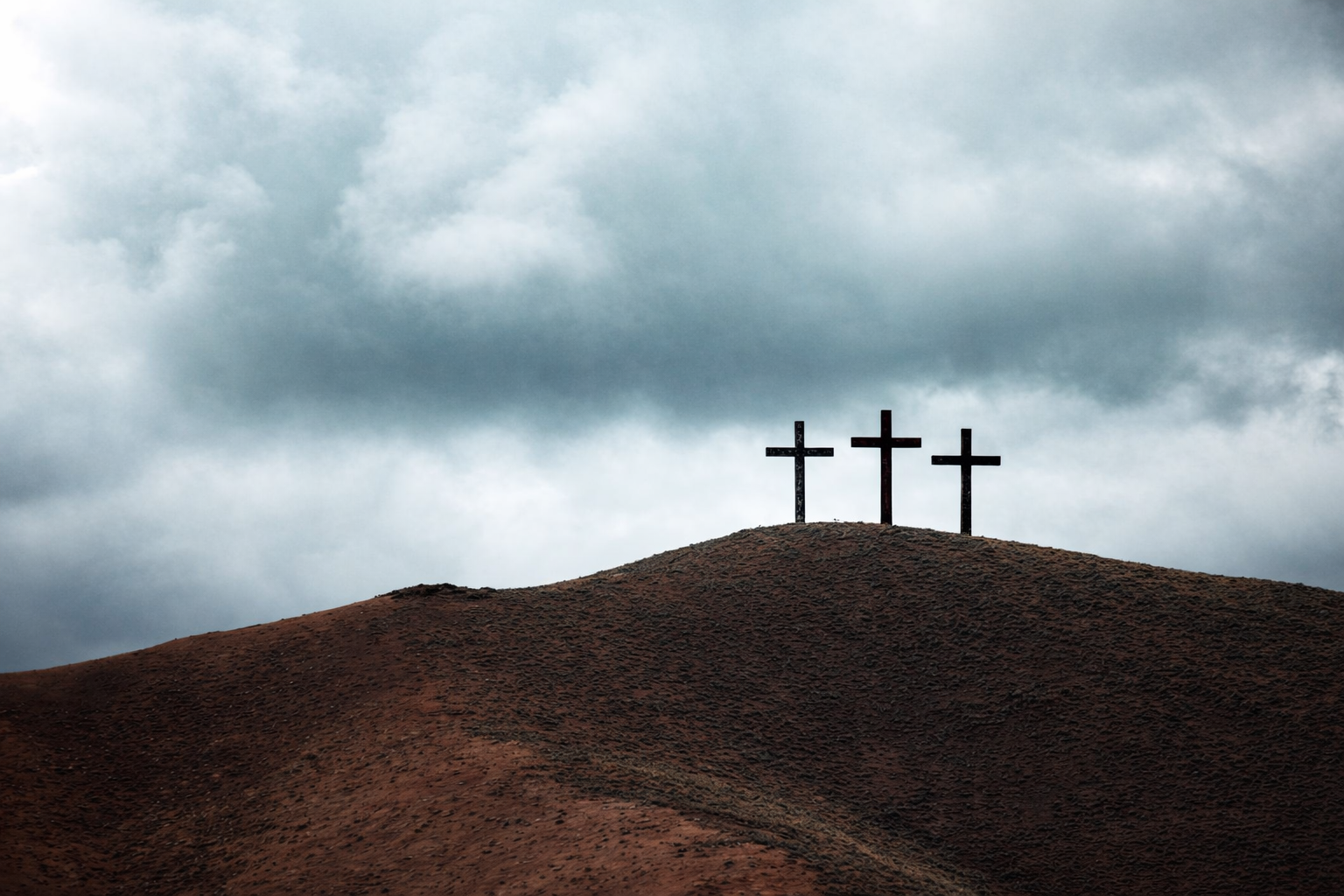
The Gospel accounts draw us into the meaning of Good Friday through words, reactions, and signs that unfold around the death of Jesus. We can reflect on these scenes as they reveal several truths about trust, sacrifice, and revelation.
The Son’s Final Dependence on the Father
At the heart of the crucifixion narrative is Jesus’ cry, “Eli, Eli, lema sabachthani?” That Jesus chose to utter these words suggests that he participated in the ultimate form of separation humans can experience: alienation from God. While it may sound like a cry of abandonment, it is far from being a collapse of faith. On the contrary, the words “my God” make it clear that Jesus still has complete trust in Yahweh. Even in suffering, there remains an orientation toward the Father.
The cry reflects the voice of the righteous sufferer as described in Psalm 22. Those who heard it would have recognized the anguish of the Jewish prayer and its movement toward vindication. Jesus’ suffering, therefore, is not isolated, but is framed within the Jewish tradition of faithful lament.
Still, those who witnessed the event didn’t understand what was taking place. Some thought he was calling Elijah. After all, it is the practice of rabbis in distress to call on the prophet for help, and so they assumed that Jesus’ cry was a desperate plea for rescue.
How many of us have become too familiar with the things of God that we often fail to recognize the meaning of what God is doing? Good Friday reminds us that divine purposes can unfold in ways that are not always immediately understood. Yes, even by those who witness them firsthand.
Jesus Chose to Lay His Life Down for Many
Jesus’ final moments on the cross are marked by surrender, even though many would consider it as desperation. Some of the bystanders who witnessed the event assumed that Jesus was seeking relief. Such was not the case. Jesus was, in fact, relinquishing his life. His death was not merely something that happened to him. He was not murdered. He chose to lay down his life.
One of the soldiers present made an attempt to offer him wine vinegar. The drink was so strong it would have revived him and prolonged his endurance. Yet, when Jesus cried, “I thirst,” it wasn’t because he wanted to quench his thirst. Some would think as though survival were still the goal. In reality, Jesus was already moving toward completion.
Even more striking was the timing of his death. It occurred close to the hour associated with the temple’s evening offering. Modern readers may not find any significance in this, but such detail carries weight in a Passover setting. His death also comes sooner than expected. In most cases, crucifixion victims would endure for extended periods.
In the case of Jesus, not even the speed of death was the defining feature. It was the manner of it. His life was not taken from him; he yielded it.

Signs From Nature
The Gospel writers describe several signs that accompanied the death of Jesus, and each one carries a theological weight.
First, darkness covered the land. Such a meteorological occurrence can be explained as heavy cloud cover, but its meaning goes beyond that. For the Jewish audiences present, darkness often conveys themes of judgment and divine action. They understood that darkness signals crisis and transformation. That an eclipse took place was also a possibility. Likewise, such an event was often seen as ominous, usually marking the death of significant figures or divine displeasure.
And then, the rending of the temple veil. Witnessed by only a few, it is described as a “hidden” sign. Scholars debate whether the Gospel refers to the inner or outer veil. Nevertheless, the symbolic implications are clear. Along with the splitting of the rocks, the tearing of the temple veil magnifies the intensity surrounding the death of Jesus. These are not subtle occurrences, but ones that signify that Jesus’ death has consequences beyond the event.
A final sign from nature was the raising of “many” holy ones. These were not mere apparitions but real resuscitations pointing toward a future resurrection. Together, these natural and cosmic signs invite us to reflect on the magnitude of the event, that the cross was not confined to a single moment or location but reverberates through creation itself.
The Gentiles Recognize Christ’s Identity
Perhaps one of the most unexpected moments in the narrative is “who” finally understands. The Jews largely failed to perceive what had happened, but the Roman centurion and those with him recognized the identity of Jesus. They were involved in the execution, yet, in witnessing the events surrounding his death, they arrived at a confession that Jesus’ own people had resisted.
It is an irony that those expected to reject Jesus came to acknowledge him, while those expected to recognize him did not. There is also great significance to the centurion’s declaration. It echoes earlier confessions but comes at the exact moment when Jesus appeared most defeated. Such recognition of Jesus’ identity didn’t arise from triumph but from the reality of the cross.

The Cross Demands a Response
Good Friday presents us with lessons from a series of contrasts. Trust within suffering. Surrender within death. Signs within darkness. Recognition from unlikely voices.
At the cross, nothing looks victorious, and yet everything that matters is being accomplished. Jesus does not escape suffering, explain it away, or resist it at the last moment. He entrusts himself fully to the Father, yields his life willingly, and in doing so reveals a kind of power that does not force, but gives.
Good Friday invites more than observation. It asks for a response. Will we stand among those who misunderstood, dismissed, or reduced what happened? Or will we recognise, even in the apparent silence and suffering, that something greater is unfolding?






Leave a Reply